
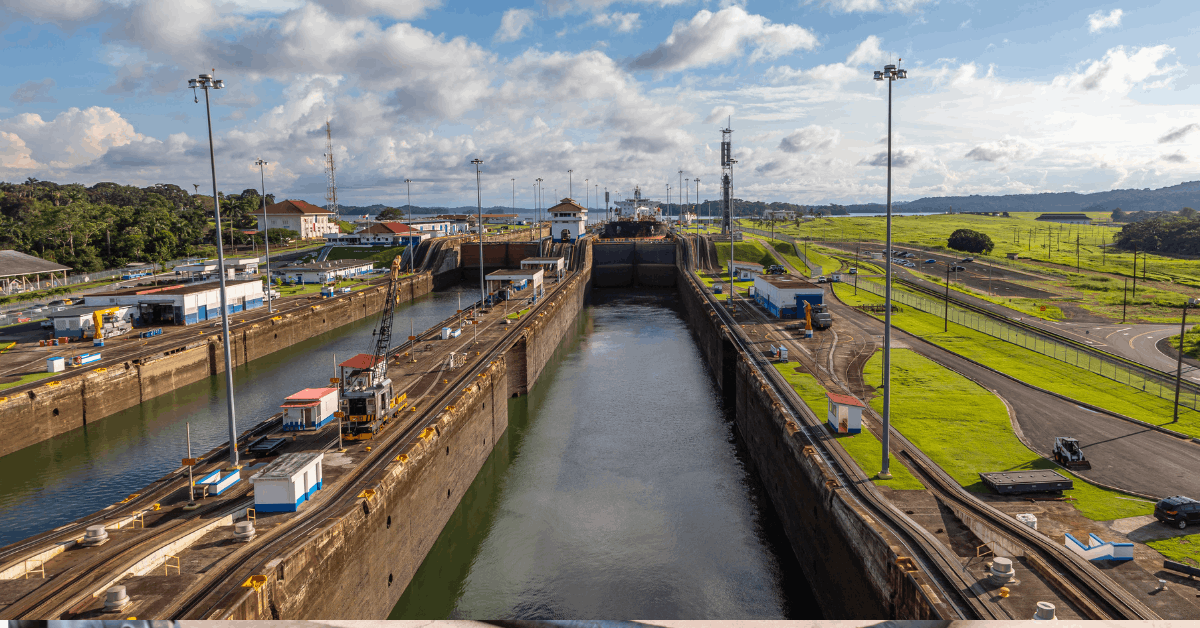
More customers have been asking us about Panama Canal shipping alternatives lately. Keep routing cargo direct through the Port of Houston via the canal, or start weighing a land bridge move through a West Coast port instead? It’s a fair question right now, and the answer has gotten more expensive to get wrong.
Key Takeaways
- A land bridge moves cargo by rail across a continent between two ocean legs — West Coast port in, rail across, East Coast or inland destination out.
- Direct-to-port skips that rail leg, but for Gulf ports like Houston, it usually still means transiting the Panama Canal.
- Canal capacity is tightening: transits capped at 34 a day from September 4, dropping to 32 from September 15, after rainfall came in 34% below average.
- Ocean carriers have already priced it in. MSC and CMA CGM both raised Panama Canal surcharges in September, and Gulf Coast cargo is in scope.
- Neither lane wins outright. It comes down to your cargo’s urgency and how much schedule risk you’re willing to carry.
Two Ways to Get Cargo Across an Ocean
Picture a container leaving a factory in Asia. There are really only two ways it gets to a warehouse in, say, Dallas or Atlanta. One way, it stays on a ship the whole time, either around the horn or through the Panama Canal, and comes ashore near its final destination. The other way, it comes ashore on the West Coast and finishes the trip by rail.
That second option is what people mean by a land bridge. Los Angeles or Seattle to Chicago to New York, double-stack rail the whole way. The first is direct-to-port, or all-water shipping. Nothing fancy about either concept, but the tradeoffs between them have gotten a lot more interesting this year.
Take a Singapore-to-New York container as an example. Go all-water through Panama, and you’re looking at 21 to 36 days depending on conditions, according to research out of The Geography of Transport Systems.
Put that same box on a West Coast landbridge instead, and it’s closer to 19 days. That gap is exactly why land bridge routing exists as an option, even though it usually costs more per container.
And here’s what matters for Gulf shippers: going direct-to-port through Houston doesn’t avoid the canal. Most of that cargo transits Panama. So when the canal tightens up, direct-to-port customers feel it whether they realize it or not.
What’s Actually Happening at the Canal
The Panama Canal Authority issued an advisory on August 20 capping daily transits at 34 vessels for booking dates from September 4, then dropping to 32 from September 15.
The canal averaged about 34 transits a day in July anyway, so the September 4 number mostly just formalizes where things already were. The real cut lands on September 15.
The reason is water, same as 2023-24. Rainfall across the canal watershed ran 34% below the historical average from May through August, and inflows into the watershed came in 44% below normal. The authority is bracing for an El Niño event expected to run into 2027.
The canal delayed a couple of previously scheduled draft cuts as part of the same advisory. A planned reduction to 48 feet got pushed to September 2, and the cut to 47.5 feet moved out to October 1.
There are fewer ships, but each one can sit deeper and carry more. That’s a deliberate trade-off, and it softens the blow somewhat.
The Part That Hits Your Invoice
Here’s where this stops being industry news and starts being a problem for you. Ocean carriers have already repriced canal risk.
As of September 12, they’re charging $149 per TEU just to cover the canal, and it climbs from there on 40- and 45-foot boxes. CMA CGM didn’t mess around either; they set theirs at $500 per TEU starting September 10.
Both apply to cargo moving from Asia to the U.S. East and Gulf Coast. That’s Houston. If your freight comes through the canal, that cost is landing on your rate regardless of what the transit numbers do next.
So Which One Actually Makes Sense?
The land bridge has gained real momentum this year on its own, separate from anything happening in Panama. J.B. Hunt set a company intermodal record in Q2 2026, and shippers leaned harder into rail as truckload capacity tightened and fuel prices spiked.
Long Beach is putting real money behind it too, a $2.2 billion rail expansion at its Pier B terminal that’s supposed to nearly triple on-dock capacity by 2032. None of that comes free, though. Adding a rail leg means an extra handoff, and West Coast rail dwell times haven’t exactly been consistent depending on the season.
Direct-to-port has the opposite appeal. Fewer moving parts. One carrier, one vessel, and when the canal’s behaving, a schedule you can actually count on. Most of the Gulf-bound freight we handle has always done fine on all-water routing through Houston for exactly that reason, since a domestic rail leg was never really necessary for that cargo anyway.
The math has shifted, though. Once you add a few hundred dollars per container in canal surcharges to your all-water rate, the cost gap between the two lanes narrows. Land bridge was always the pricier option. It’s less pricey than it was in June.
If your cargo can’t slip, or you’re shipping into the teeth of this El Niño window, spend the hour and price out a West Coast landbridge move. It’s worth knowing what it’d actually cost before you need to know.
But if your timing has some give in it, or you’ve already got Gulf drayage and warehousing working the way you want, direct-to-port through Houston probably still comes out ahead, especially with the draft delay letting ships load heavier than anyone expected this fall.
Most shippers we talk to end up doing a bit of both. Steady volume keeps moving direct-to-port, and there’s a landbridge option sitting in a drawer, already priced, ready to pull out if winter goes sideways.
Either Way, Somebody Has to Move It the Last Mile
No matter which lane wins out for a given shipment, that container still has to come off a vessel or a railcar and end up in a warehouse or on a delivery truck. That’s where we fit in. We run container drayage for direct-to-port cargo through Houston, and intermodal trucking for freight coming off a West Coast landbridge move.
If you want help figuring out which lane makes sense for your next shipment, or you’d rather have a backup plan ready in case Panama tightens further, reach out. We’re happy to talk it through.
Frequently Asked Questions
What is the difference between a land bridge and direct-to-port shipping?
With a land bridge, your container comes off the ship at one coast, rides the rail across the continent, and picks up its next ocean leg from the other side. Direct-to-port skips all that; the box stays on the vessel until it reaches the port it’s actually headed for.
Why is the Panama Canal restricting transits in 2026?
There’s not enough rain. Watershed rainfall ran 34% below average from May through August, and inflows were down 44%, which pulls down Gatun Lake. Each transit uses fresh water that only rain can replace, so daily crossings will be capped starting in September.
How much are Panama Canal surcharges costing shippers?
It depends on the carrier. MSC set its surcharge at $149 per TEU from September 12, while CMA CGM moved to $500 per TEU from September 10. Both apply to Asia cargo bound for the U.S. East and Gulf Coast.
Is land bridge shipping always faster than direct-to-port?
Not always, but it can be significantly faster on specific routes. A Singapore-to-New York shipment can run roughly 19 days via the North American land bridge compared to 21-36 days via the Panama Canal, depending on conditions.